
Knowledge base

Are you looking for practical advice on thermal insulation and modern building systems? Our Knowledge Base is your source of reliable information about PIR thermal insulation boards, their applications and advantages. We answer the most frequently asked questions from investors and contractors – simply, concisely and with expert knowledge.

Knowledge base
6 March 2026
EUROPIR® DUAL thermal insulation board for clinker brick facades
The EUROPIR® DUAL thermal insulation board is an innovative product that combines rigid PIR foam without cladding, designed specifically for insulating facades finished with clinker tiles. Specially designed mounting guides…
Read more
EUROPIR w Systemie ETICS – rozwiązania dla efektywnego ocieplenia
6 March 2026
EUROPIR in the ETICS System – solutions for effective insulation
  In view of growing requirements for energy efficiency and living comfort, the right choice and proper installation of a building insulation system is becoming crucial. Both in newly constructed…
Read more
6 March 2026
Clean Air Programme – thermal modernisation of a house with EUROPIR panels
In the face of rising energy costs and energy regulations, thermal modernisation of your home is becoming crucial. By choosing EUROPIR® PIR boards, you are not only investing in comfort…
Read more
Calculator Background

Useful tools

CALCULATOR THICKNESS

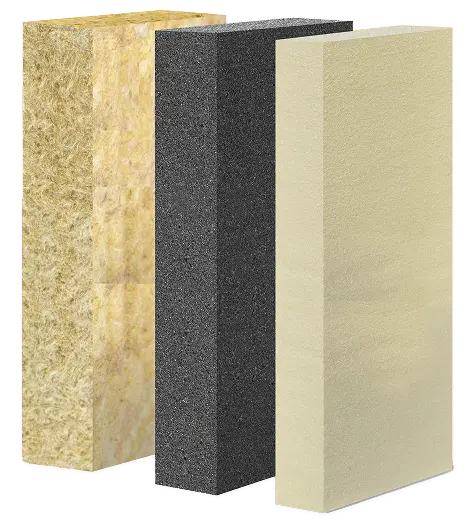
EUROPIR® boards are distinguished by their very low declared thermal conductivity coefficient (λd). This feature makes it possible to achieve the legally required heat transfer coefficient (U) of a building partition using a significantly thinner layer of insulation.
Read more
Kalkulator zdjęcie
Mineral Wool
λd = 0.040 (20 cm)
EPS polystyrene foam
λd = 0.033 (16.5 cm)
EUROPIR® board
λd = 0.023 (12 cm)

Do you have any questions?

See what customers ask most often

Thermal resistance is one of three values that determine the thermal insulation of a building partition. Calculating thermal resistance requires knowledge of the lambda coefficient and the thickness of the material. Formula: R = d/λ, where d is the thickness in metres and λ is the thermal conductivity coefficient.

Thermal resistance R characterises a material of a specific thickness and is equal to the quotient of the material thickness and the thermal conductivity coefficient lambda. The unit of thermal resistance is (m²·K)/W. When selecting insulation material, thermal resistance R is more important than the lambda coefficient itself, as it takes into account the thickness of the material.

The heat transfer coefficient is a parameter indicating the amount of heat that flows through one square metre of a partition per second when there is a temperature difference of 1 K (Kelvin) between both sides of the partition. The unit of the heat transfer coefficient is W/(m²·K). Lambda λ is the thermal conductivity coefficient, i.e. the property of a material that determines its ability to conduct heat.

The standard dimensions of PIR boards manufactured at PCC Therm, without cladding and with aluminium cladding, are 1200 x 600 mm. The boards are manufactured in thicknesses ranging from 20 mm to 300 mm in 10 mm increments, as well as in thicknesses of 25, 35, 45, 55, 65, 75, 85 and 95 mm. It is also possible to manufacture boards in non-standard thicknesses and dimensions.

Compressive strength is a mechanical property of a material that characterises its ability to transfer compressive loads. It is the compressive stress at which the material deforms by a specified amount (usually 10% of the sample height). According to the standard, compressive strength is determined by compressing the sample in a direction parallel to the surface of the board (in the direction of thickness). Compressive strength should not be confused with compressive strength.

files to download

Baza wiedzy
EUROPIR® product technical data sheets
Pobierz
Baza wiedzy
Catalogues
Pobierz
Baza wiedzy
Terms and conditions of sale
Pobierz